Today students had the opportunity to practice their design before officially beginning their IA next week. Many of you realized that you needed to change your procedure, use smaller quantities or just by chance chose the optimal time for your experiment to run.
Below are link to the manuals for the Vernier Probes you might have chosen for this experiment. These manuals also include the actual uncertainties for the equipment as established by Vernier.
Gas Pressure sensor
pH sensor
Temperature sensor
For Monday (or Tuesday) set a goal for your self. You have four hours of class time to complete this experiment, so manage your time wisely.
Showing posts with label Topic 7. Show all posts
Showing posts with label Topic 7. Show all posts
Saturday, March 10, 2012

Monday, March 5, 2012
Enzymes HL Topic 7 and SL Option C
Today (or tomorrow for H period) we continued learning about enzymes. By the end of this class students were able to:
Click here for an animation demonstrating a biochemical pathway.

State that metabolic pathways consist of chains and cycles of enzyme- catalysed reactions.
Describe the induced-fit model.
Explain that enzymes lower the activation energy of the chemical reactions that they catalyse.
Below are the animations we used in class.
 |
| Blood clot formation is an example of a metabolic pathway. |
Below is a great tutorial on energy and enzymes, click the picture to link to the tutorial.
Homework: A final reminder that your Design IA is due tomorrow in class. You must submit a printed copy.
Friday, February 24, 2012
Enzymes Internal Assessment
Today we spent half the period discussing your first official Internal Assessment and the remaining half of the class reviewing your test on Topics 3.1-3.5 and 7.1-7.4.
On Wednesday March 7th, you must submit a completed Design for this experiment. Essentially this Design would be suitable for submission to the IB. You will have Friday March 9th to play in class and tweak your design. You will be graded on the Design that you submit on March 7th and this will be the last grade you have before midterms.
A Title
Research Question & Background Information
Null Hypothesis (Ho) and Alternative Hypothesis (Ha)
Table that lists the Independent & Dependent Variables, as well as Controls.
Materials (with uncertainties)
Photograph of experimental set up ** You do not need to include this at this time, however you do need to identify a space for it in your paper. ** You do not need to include a protocol diagram.
Method (listed in steps).
A data table
* If you research information on this topic, you must cite it in your Design. This includes information contained in the Background section.
* As you are designing the experiment be mindful of how you will collect the data, since you will actually be doing this experiment.
* Internal Assessments count for almost 25% of your overall IB grade. Since unlike a test, you know exactly what your Internal Assessment will cover, you should take the extra time to make it perfect.
* Refer to the rubric you received for the Osmosis Design Lab for more details on the requirements.
You will be investigating the decomposition of hydrogen peroxide by catalase.
 |
Your Design should have:
A Title
Research Question & Background Information
Null Hypothesis (Ho) and Alternative Hypothesis (Ha)
Table that lists the Independent & Dependent Variables, as well as Controls.
Materials (with uncertainties)
Photograph of experimental set up ** You do not need to include this at this time, however you do need to identify a space for it in your paper. ** You do not need to include a protocol diagram.
Method (listed in steps).
A data table
A couple of things to keep in mind:
* Your lab design can not be identical to another student (even if they are in a different period). * If you research information on this topic, you must cite it in your Design. This includes information contained in the Background section.
* As you are designing the experiment be mindful of how you will collect the data, since you will actually be doing this experiment.
* Internal Assessments count for almost 25% of your overall IB grade. Since unlike a test, you know exactly what your Internal Assessment will cover, you should take the extra time to make it perfect.
* Refer to the rubric you received for the Osmosis Design Lab for more details on the requirements.
Wednesday, February 15, 2012
Helpful Review Links
Since the International Food Fair is Thursday night and E period had some pretty good arguments for postponing the test, your test is now on Monday (for E period) or Tuesday (for H period).
Here are some links to help you review:
DNA Replication - silly
DNA Replication - also has review quizzes
Transcription and Translation - Basic : From DNA Dolan Learning Center
Transcription and Translation - Advanced : From DNA Dolan Learning Center
DNA Replication - also has review quizzes
Transcription and Translation - Basic : From DNA Dolan Learning Center
Transcription and Translation - Advanced : From DNA Dolan Learning Center
Tuesday, February 14, 2012
H Period Homework Help
H period homework:
Please complete questions 9, 10 and 11 in the packet. Use the PowerPoint and the links in the post below.
For question #9:
 |
| Click the picture to link to an animation and explanation on how tRNA is activated. You do not need to know the term aminoacyl-tRNA synthetase. |
For Question #10:
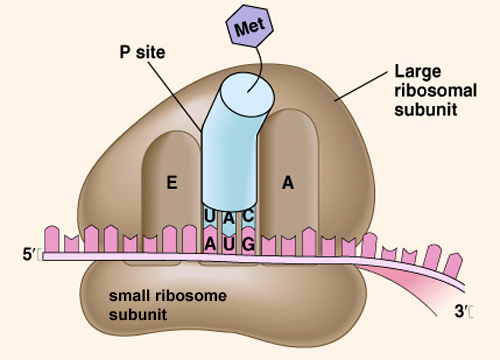 |
| The structure of a ribosome. |
For Question #11
 |
| Visit Hartmut "Hudel" Leucke's lab page by click on his picture of a polysome, for a great explanation of how these ribosomes work together. |
Monday, February 13, 2012
Topic 7: Transcription & Translation
Today we reviewed the core information on transcription and translation, before moving on to the details of these processes in topic 7. Below is the PowerPoint from Mr. T for these sections.
A detailed explanation of the activating enzyme reaction that joins the amino acid to the tRNA
A detailed explanation of the structure of tRNA. This is far more detail than you need to know, but can be helpful in understanding the structure.
E period homework: Complete questions 6, 7 and 8 in the packet.
Protein Synthesis: 7.3 & 7.4 Transcription and Translation AHL (IB)
See an electron micrograph of a polysome (and for an explanation) here.
View more presentations from Stephen Taylor
A detailed explanation of the activating enzyme reaction that joins the amino acid to the tRNA
A detailed explanation of the structure of tRNA. This is far more detail than you need to know, but can be helpful in understanding the structure.
E period homework: Complete questions 6, 7 and 8 in the packet.
Thursday, February 9, 2012
Wrapping up Replication
Today E period had a "Most of you Didn't Do Your Homework, so You have a Pop Quiz" Quiz. We spent the remainder of the period clarifying any questions on DNA replication.
Tomorrow we will start transcription and translation. Remember to write in your planners that on February 17th (Friday) you will have a test on the current syllabus packet. Topics are listed in the sidebar.
Tomorrow we will start transcription and translation. Remember to write in your planners that on February 17th (Friday) you will have a test on the current syllabus packet. Topics are listed in the sidebar.
Monday, February 6, 2012
DNA Replication
Today we started DNA replication. We used this animation to help us learn the basics. St. Olaf's explanation, here, is also very easy to understand. For homework, due Wednesday: complete all of the packet, except the back of the last page.
Watch the Mechanisms of DNA replication below. Without the sound can you identify which is the leading strand and which is the lagging strand?
Watch the Mechanisms of DNA replication below. Without the sound can you identify which is the leading strand and which is the lagging strand?
Thursday, February 2, 2012
7.1 - DNA Structure
Today we went into more detail on the structure of DNA, specifically addressing, how does all of that DNA fit into such a small space?!
Tomorrow we will finish 7.1 and work on a review of 7.1 and 3.3. Homework for tonight (due tomorrow): Complete the DBQ on page 58 in your book. This will be the last grade before interims! Tomorrow you will get back your tests on Topic 2.
 |
| Click to watch a video on how histones are used to package DNA |
Subscribe to:
Posts (Atom)